How to Describe End Behavior Using Limit Notation
If either limit holds we call the line y L. We look at this again in the next lesson.
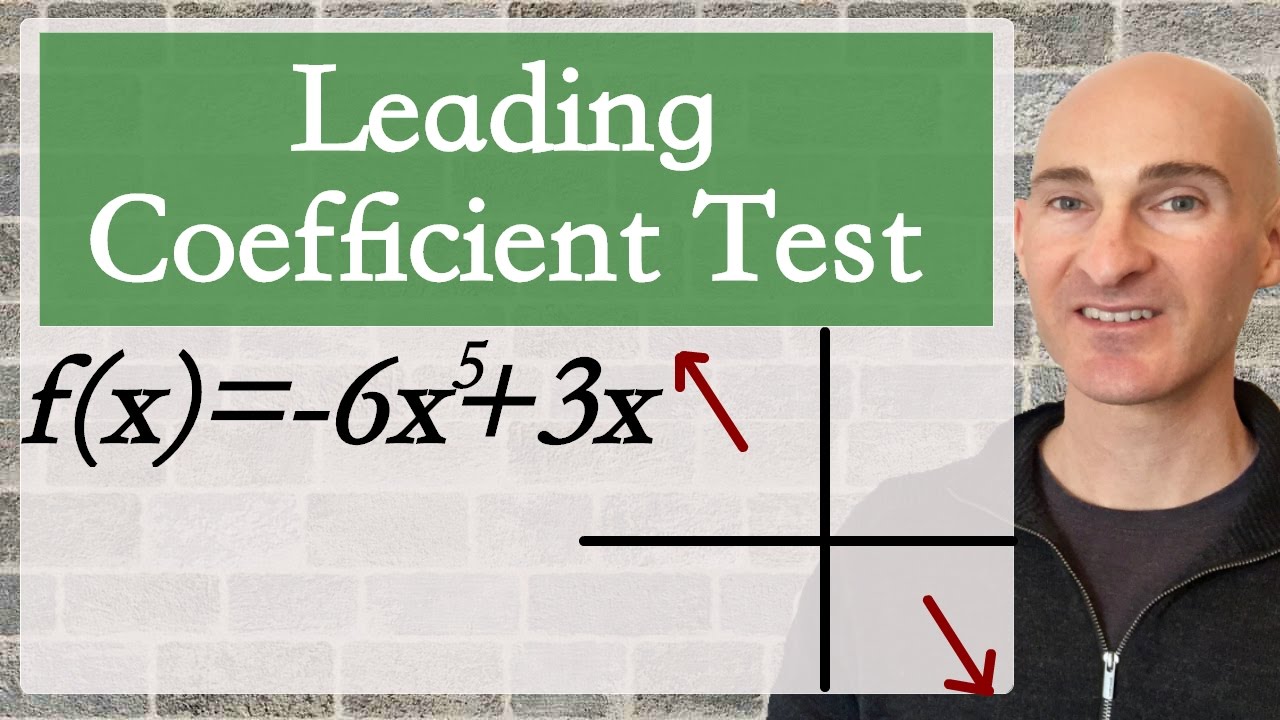
Describing End Behavior Using Limit Notation Youtube
Use and interpret limit notation to describe the end behavior of functions.
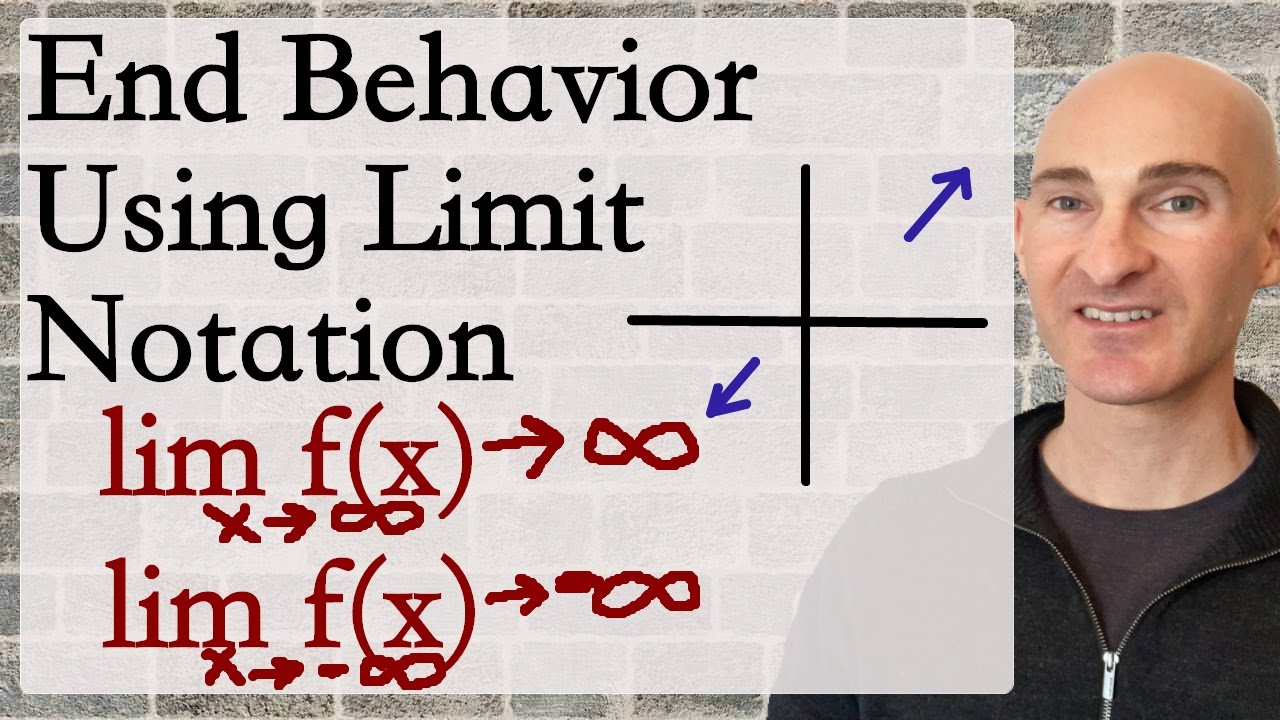
. When we evaluate limits of a function as x goes to infinity or minus infinity we are examining something called the end behavior of a limit. In order to determine the end behavior we need to substitute a series of values or simply the function determine what number the function approaches as the range of the function increases or decreases towards infinity or minus infinity. Describe the end behavior of the function using the limit notation.
Intro to end behavior of polynomials. End behavior means that we want to know what the values do as gets very large in magnitude both positive and negative. Determine the end behavior of different kinds of functions including those that approach a particular value those that approach infinity and those that follow neither pattern.
A B C May 22925 AM We know that the n-gon will NEVER actually be a circle but it will get REALLY close. Sketch a graph of the reciprocal function shifted two units to the left and up three units. Up to 10 cash back Find the end behavior of the function x 4 4 x 3 3 x 25.
There is a good video called Describing End Behavior Using Limit Notation by Marios Math Tutoring and it helps to show you how to find the end behavior with limits. When becomes greater and greater we say that approaches infinity and we write. For example if we wanted to describe the end behavior of fx x2 f x x 2 we would say fx f x as x and as x.
Use arrow notation to describe the end behavior and local behavior for the reciprocal squared function. A Identify and classify all discontinuities. Learn how to determine the end behavior of the graph of a polynomial function.
Use limit notation to describe the end behavior of the following functions. Describe the end behavior using limit notation for the following functions. End behavior of polynomials.
Using Transformations to Graph a Rational Function. Endbehaviorfxlnx-5 endbehaviorfxfrac1x2 endbehavioryfracxx2-6x8 endbehaviorfxsqrtx3. Use the degree and the leading coefficient to determine the behavior.
So the end behavior is. 112Finding Limits SMART NOTES 1 May 13 2014 May 13306 PM Use LIMIT NOTATION to identify the end behavior of each of the following graphs. End behavior of polynomials.
The limit notation condenses this phrase. Learn what the end behavior of a polynomial is and how we can find it from the polynomials equation. Use the concept of limit to describe the end behavior of functions.
Learn how to determine the end behavior of the graph of a polynomial function. In this video we use limit notation to describe the end behavior of various functions. Figure 132 illustrates the end behavior of a function f when lim x fx L or lim x fx L In the first case the graph of f eventually comes as close as we like to the line y L as x increases without bound and in the second case it eventually comes as close as we like to the line y L as x decreases without bound.
End behavior of polynomials. Click here to see ALL problems on Polynomials-and-rational-expressions. When becomes more and more negative we say that approaches negative infinity and we write.
F x -2x4-3x33x-5 I m not sure how to format this as an answer and the steps confuse methank. To do this we will first need to make sure we have the polynomial in standa. I m not sure how to format this as an answer and the steps confuse methank you.
This video corresponds to the file under NOTES. Begin alignfrac 1 3frac 1 9frac 1 27 cdotsfrac 1 2end align begin alignlim limits_ n to infty sum limits_ i1n left frac 1 3 right ifrac 1 2end align. B Describe the end behavior using limit arrow notation.
The graph looks as follows. Experts are tested by Chegg as specialists in their subject area. To do this we will first need to make sure we have the polynomial in standa.
The following video shows how asymptotes can be used to sketch the graph of a rational function. The degree of the function is even and the leading coefficient is positive. Learn how to describe the right hand and left hand end behavior of a function using limit notation in this free math video tutorial by Marios Math Tutoring.
Continuity End Behavior and Limits End Behavior The end behavior of a function describes what the -values do as becomes greater and greater. This is the currently selected item. Up to 24 cash back This video introduces the idea of using limit notation to describe the behavior of a graph near asymptotes.
Who are the experts. Therefore we look at limits as as increases without bound and as as decreases without bound To find end behavior of a polynomial function you only need to look at the. Use limit notation to represent the following mathematical statement.
Identify the horizontal and vertical asymptotes of the graph if any. Use this Desmos link to answer the following questions about fx 1 x. Limxafx L means as x a fx L.
Use limit notation to describe the unbounded behavior of the given function as x approaches and as x approaches. F x as x f x as x. A Identify and classify all discontinuities.
Google Classroom Facebook Twitter. B Describe the end behavior using limit arrow notation.

End Behavior Discovery Intro Start With A Basic Introduction To Vocabulary Degree Leading Coefficient Polynomial Functions Studying Math Teaching Algebra

Describing The End Behavior Of Graphs Using Limits Youtube
Describing End Behavior Using Limit Notation Youtube


Comments
Post a Comment